
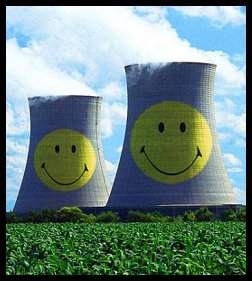
 How precarious has our climate predicament become? Bad enough that four prominent climate scientists — including one very prominent activist — are now publicly calling on major environmental advocacy organizations to embrace nuclear power. Yes, nuclear power.
They say nuclear energy must be included as a necessary tool in meeting rising global energy demand while reducing global greenhouse gas emissions if humanity is to have any hope of keeping global temperatures from rising more than 2 degrees Celsius above pre-industrial levels, and that “continued opposition to nuclear power threatens humanity’s ability to avoid dangerous climate change.”
In a letter, authored by James Hansen (retired NASA scientist, now with Columbia Univ.), Ken Caldeira (Carnegie Institution), Kerry Emanuel (Massachusetts Institute of Technology) and Tom Wigley (National Center for Atmospheric Research and the University of Adelaide), the four assert that renewable energy sources such as wind and solar cannot be deployed fast enough to meet global energy needs while still avoiding dangerous, potentially catastrophic, climate destabilization.
Not everyone agrees, but they’ve certainly grabbed the attention of environmentalists.
The four scientists ask the nation’s largest, most prominent environmental organizations to support development of new nuclear technology because, they say, “there is no credible path to climate stabilization that does not include a substantial role for nuclear power”…
In the letter, they write [emphasis added]…
As climate and energy scientists concerned with global climate change, we are writing to urge you to advocate the development and deployment of safer nuclear energy systems. We appreciate your organization’s concern about global warming, and your advocacy of renewable energy. But continued opposition to nuclear power threatens humanity’s ability to avoid dangerous climate change.
…
While it may be theoretically possible to stabilize the climate without nuclear power, in the real world there is no credible path to climate stabilization that does not include a substantial role for nuclear power.
…
With the planet warming and carbon dioxide emissions rising faster than ever, we cannot afford to turn away from any technology that has the potential to displace a large fraction of our carbon emissions.
While acknowledging the many problems with nuclear energy, the four climate scientists assert that advances in “21st century nuclear technology” can adequately address entrenched public opposition to nuclear power — issues with safety, radioactive waste, and weapons proliferation. They argue that nuclear power is the only technology that can meet rising global demand for cheap, reliable energy while at the same time sharply reduce greenhouse gas emissions.
Major national environmental advocacy organizations, such as the Sierra Club, have long opposed nuclear power as “a uniquely dangerous energy technology for humanity.”
Hansen, one of the four authors, was the first scientist to bring the dangers of global warming to mainstream prominence when he testified before the U.S. Congress in 1988. Hansen has since retired from NASA to focus on climate activism, and was arrested alongside Sierra Club Executive Director Michael Brune in February for protesting against approval of the proposed Keystone XL pipeline in front of the White House. He famously described the full exploitation of the massive Canadian tar sands oil deposits via the Keystone XL pipeline as “game over for the climate.”
Alan Nogee, former Energy Program Director with the Union of Concerned Scientists, responded to the scientists’ letter via Twitter, contending that the authors “misstate and exaggerate” the shortcomings of renewable energy deployment, suggesting they have overlooked the far higher costs of new nuclear power plants, the industry’s massive taxpayer subsidies [PDF] and the cost of special protection from liability in the event of an accident.
Ralph Cavanagh of the Natural Resources Defense Council (NRDC), downplayed the letter, telling CNN, “I don’t think it’s very significant that a few people have changed their minds about nuclear power.” He says that, while the NRDC hasn’t rejected nuclear power out of hand, the safety issues and costs are too high.
According to the Washington Post, NRDC President Frances Beinecke echoed Cavanagh’s sentiments, saying in a statement, “The better path is to clean up our power plants and invest in efficiency and renewable energy.”
The pro-nuclear advocacy of the four scientists was also met with some pushback from renewable energy industry advocates and academics across social media, questioning the authors’ familiarity with the rapidly-changing renewable energy sector. As reported in a recent Green News Report, Stanford University’s Mark Jacobson, Director of Stanford’s Atmosphere/Energy program, argues renewable energy sources are capable of meeting 100% of the world’s energy needs with currently available technology.
Longtime solar advocate and anti-nuclear activist and author Harvey Wasserman of NukeFree.org wasn’t nearly as polite. “Renewable energy, along with increased efficiency, is more than ready to power our entire planet safely, cheaply and cleanly,” he told The BRAD BLOG tonight. “The four scientists who have advocated more nuclear power as a solution to global warming should go to Fukushima. No technology but nuclear is capable of inflicting upon us all the horrifying catastrophe now unfolding [there]. Instead of wasting our time and insulting our intelligence by advocating still MORE nuclear reactors, these scientists should lend their alleged expertise to do whatever they possibly can to contain the harm being done at Fukushima. To do less is grotesquely irresponsible.”
In international climate treaty negotiations, world governments have agreed to target 2C above pre-industrial levels as their goal to reduce global emissions of heat-trapping gases. Mainstream climate science indicates limiting global temperature rise to 2C will likely still result in dangerous, but adaptable, impacts. As international climate treaty negotiators prepare for the next round of talks later this month, a leaked draft of the upcoming report projecting climate change impacts from the Intergovernmental Panel on Climate Change (IPCC) concludes that global warming is already impacting the global food supply, and that overshooting the 2C target will lead to devastating drought, heat waves, famine and war.
That’s bad enough, but a report published recently by the journal Nature Climate Change concludes that, with current emissions growth, the globe is on track for a rise in temperatures between 4C and 6C. Buckle up.
* * *
Desi Doyen is the co-host and managing editor of The BRAD BLOG’s Green News Report, the producer of KPFK’s The BradCast and a frequent guest host on The Young Turks. Follow her on Twitter at: @GreenNewsReport.























So what do those four have to say about Fukushima? I’m honestly curious to know. It would seem that the ongoing aftermath of that catastrophe would be all the evidence necessary for abandoning a future in nuclear power.
Sort of a pick your poison approach. But nothing really new for Hansen. He suggested the same thing in his book, Storms of My Grandchildren, which, of course, he wrote before Fukushima.
People can claim nuclear power is safe all they want. It doesn’t matter when those running the industry cut corners and hide problems from both the government and the people. Worse yet, when the government lets them hide issues.
A large nuclear power program could only generate a few percent of current power requirements, never mind increasing power usage. It’s environmentally superior to burn coal for the difference. Nuclear plants generate considerable heat that wouldn’t be on Earth otherwise, adding to the planetary heat load. Not exactly helping out the global warming scenario, particularly when wind, solar, and water convert to electricity elements that are all ready accounted for in relation to heat generation. It’s not all about gasses, it’s also about the burning.
… R @ #4 said…
That’s pretty much completely
wrong.
The Earth is actually a multi-petawatt class radiator floating in space.
Global insolation is 1.73E+17 – what hits Earth from the Sun or 173 petawatts
The albedo factor is 0.3 – 30% of the solar input bounces right back into space.
Global absorbed solar is 1.21E+017 – 70% of the solar sticks around long enough to warm things up. That’s 121 petawatts.
And almost all of that is eventually reradiated as well.
And as for antrhopogenic heat? The heat we humans add comes to about 1.80E+013 watts… or 18 terawatts.
And 18 TW is nothing much from a global standpoint.
No, the problem is very much the gas. An analogy is that we’ve been coating that multi-petawatt radiator with carbon, so to speak, and the extra trapped heat from the sun, although small in relation to the total solar input, is what is actually frying us…
… and that extra trapped solar heat is what will kill us if we keep pouring CO2 into the atmosphere.
The heat actually generated by humanity doesn’t count for all that much at this time.
I’m going to be the odd duckling and agree with the professionals: Nuclear does need to be a part of the conversation and it hasn’t been. The reactors we have now, Fukishima included, are long past their due date and need to be replaced with newer more efficient reactors. We’re not because we have a populace that has been convinced thanks to blunders like Fukishima that nuclear energy is dangerous and renewables can fill our demands right this very minute. Not to mention other factors like the glut of natural gas, cheap oil, energy monopolies, and a congress that refuses to work. If the concern is over waste, maybe we can start by allowing reprocessing in the states.
Fission power is not the answer. In fact nuclear fission is the second choice of the elites for maintaining their control over energy sources… their first choice, of course, was and is
fossil fuels.
But the plutocrats and their supporting oligarchy, the ones whose energy policies are responsible for the climate disaster in the first place, have
succeeded in convincing Hansen et al that their choice is what will save humanity.
… and they’re lying.
Again.
I wonder if they will change their tune when Fukushima goes “Nukular”…meaning when the cooling pool hanging one hundred feet in the air, collapses and we will have to move California somewhere else…
Robert Pool @6,
You wrote
A nuke talking point that is discredited and systematically wrong.
San Onofre was recently refitted with “the new good stuff” but lasted only a short time before having to be shut down permanently.
There is no “clean coal” and there is no “safe nuclear” in the real world.
But there is incredibly abundant clean and safe renewable energy.
We need desperately to lose the ecocidal and suicidal mania in our culture.
Let me add Amory Lovins’ deconstruction of the misguided pro-nuclear notion.
http://www.pbs.org/wgbh/nova/in...ar-lovins.html
Thanks for the link to the Amory Lovins article, David Lasagna.
This passage sums up his argument:
Today is Million Mask March day, which includes protests against Nuclear as well as advocacy for clean renewable energy.
@zapkitty
“That’s pretty much completely
wrong.”
You think I disagree with what you said, when you support your statement that what I said is “pretty much completely wrong?” I don’t discount the gasses, yet you say I do. I am aware of 1000w of heat per sq meter falling on the planet surface. You speak of an energy gradation, I think in terms of tipping points. Drop dead, if you think we’re on the opposite sides of things. Get real, not rude. You should have also remarked on what I said that is right, and incorporated those. I could write pages on this stuff. It’s a damned blog, ya bum.
R
It isn’t just the touch-screens that are the problem — and readers should know that Karl Rove has his fingerprints on election fraud across America.
Since 1988 when Rove was involved with George Herbert WALKER Bush’s campaign (they go back together to 1980), exit polls — the gold standard of election verification — have been currupted (media uses word “adjust”) so that they match unverifiable proprietary vote counts.
… R said @ #13…
You miss the point. At this time the effects of anthropogenic heat on the global heat budget amounts to zilch.
Greenhouse gases, CO2 et al, have their effect by allowing more solar heat to be trapped”¦ they leverage solar power and thus they can have their devastating effect.
Indeed, total global effects from human-created heat are much less than even natural solar variance.
global insolation in watts (sunlight hitting Earth):
1.73E+17
albedo of Earth (what gets reflected): 0.3
global absorbed watts:
1.21E+17
insolation variance (natural variations):
+-0.1%
that variance in watts:
+-1.21E+14
anthropogenic waste heat:
1.80E+13
In other words human waste heat is much less than even solar variance.
So yes, your argument is wrong.
The heat generated when we produce power is not the problem. The pollutants that results from the way that we produce power is the problem.
Eventually, should we survive, humanity will run into limits on how much heat we can produce on Earth… but we are far, far away from those limits at this time.
As for anthropogenic heat triggering a tipping point? That would be a silly thing to worry about because if we get that close to the edge then a rash of sunspots would have greater effect than the heat we produce.
… anna minity said @ #14
I think this was intended in response to Brad’s post here.
I would never ever advocate a boiling water reactor design simply because the fuel gets brittle easily and the waste byproducts are toxic for 10’s of thousands of years and also useable in weapons programs.
However, I do believe there is anther way, the liquid flouride thorium reactor. No light water that can by easily converted to explosive hydrogen. No brittle solid fuel rods, no weapons grade by-products and in fact, it can consume weapons grade materials.
http://www.economist.com/blogs/...rence-engine-0